
Truck loading
Smart Palletizing
Geodot calculates the pallet plan while the route is being built, so every order is assigned knowing whether it fits on the truck. A bottler in production had 100 trucks under contract for volume that needed 150, and 50 went out on a second run.
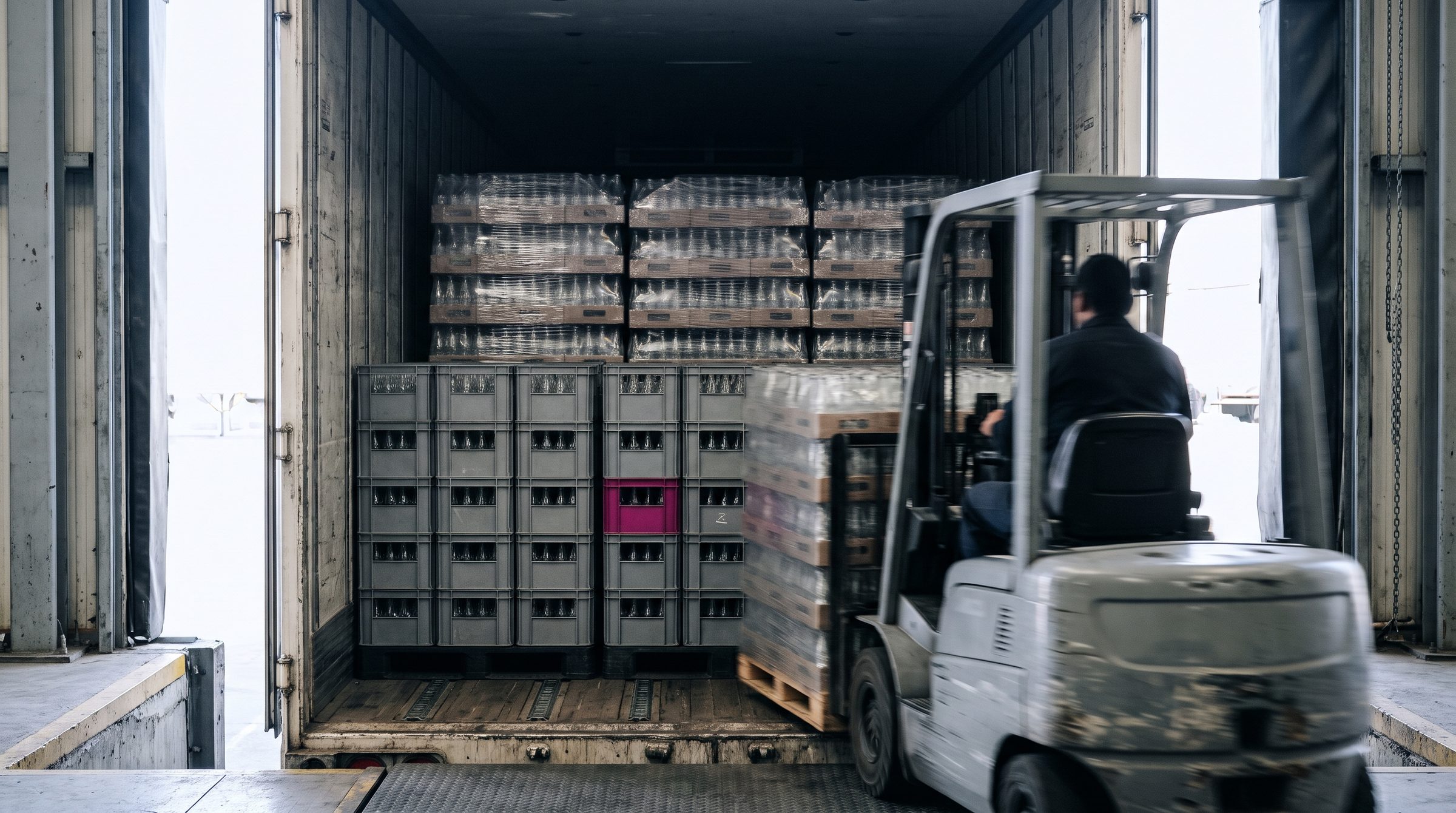
Trucks that leave with free space as a precaution
- Space is left open on every truck in case the order does not fit.
- Build rules live with the experienced palletizer and are not in the system.
- A truck that repeats the trip pays twice for fuel, crew and wear.
- The mandatory margin for returnable glass cuts the capacity of every truck.
What the system calculates with every order
Recalculated with every order
When an order is added to a route, the system recalculates the pallet plan and shows whether the customer fits, what goes on top, what goes below and how much of each product.
Rules of the trade
Glass goes at the bottom and each load carries its margin. Stacking is set by product, family, customer, fragility and legal axle weight.
Returnable glass
Moving a customer with glass to another truck frees room for more orders on the first one. At the bottler, that rule reduced the trucks needed each day.
Build guide
Which product goes in each layer and position, in step-by-step sequence. The operator checks the build against the guide, layer by layer.
Routing and palletizing in one calculation
Every time you move a customer from one truck to another, the pallet plan is recalculated on the spot and tells you whether it fits. That removes the load margin trucks used to leave empty, just in case.
Trip pallet plan
Trip 0417 · 26-position semi-trailer
Pallet 07 · build order
1.20 × 1.00 m pallet · 2 delivery stops
- 1.The heaviest cartons at the baseFour large cartons for stop 2 make a flat floor.
- 2.Heavy cartons on the axis, on a firm baseThe second layer is turned to interlock the base joints.
- 3.Medium boxes and packs by stopMedium cartons for stop 2 on one side. The packs for stop 1 on the side unloaded first.
- 4.Fragile on topSmall cartons and the fragile carton last, with nothing heavy above.
- 5.Stretch film and height checkWrapped, then checked against the 1.60 m limit.
- Heavy freight
- Medium and light freight
- Film-wrapped pack
- Fragile
- Current step
Build result
- Usable volume filled
- 81%
- Total weight
- 340 kg
- Height above the pallet
- 1.30 m
- Centre of gravity
- 0.44 m high · 1 cm off axis
Routing without palletizing
Loaded with a load margin
85%
Routing and palletizing together
Loaded with what fits, calculated
99%
- Trip load
- Added customer
- Empty margin
You moved 1 customer from R‑07 to R‑12 · Pallet plan recalculated: it fits
- 01Know what fits before loadingThe router checks with the palletizer on every change. The truck turns green if the load fits and red if it does not.
- 02Build rules in the engineHeavy, sturdy freight goes at the bottom, fragile freight on top, and nothing heavy above it. Each pallet is built in unloading order and stays under the height limit.
- 03Load margin as a ruleThe margin the operation requires is part of the calculation and holds on every truck.
0%Average truck load at a bottler in production, up from 85%
- 8% Lower transport cost in the same operation
- 10% More capacity from the returnable glass rule
- 4 to 5 trucks Fewer per day with that rule
Let's measure your spare capacity on one day of orders
With one day of orders and your fleet, we run routing and palletizing together and show how many trucks you need.